Many patients experience persistent knee pain following meniscus surgery. ATRO Medical offers a solution with its Artimis®: an artificial meniscus that relieves pain and helps patients return to their daily activities. Chief Implementation Officer Maarten van der Zanden explains how ATRO Medical is developing this technology, the role its partners play in this, and what the future holds.
ATRO Medical was founded in 2017 with a mission: to develop a synthetic solution for the countless patients suffering from a damaged meniscus, one of the most common knee problems. “Whilst I was finishing my degree in 2006, I happened to be present at a brainstorming session about this product,” says Maarten. “The founder and inventor of Artimis®, Tony van Tienen, has been involved from the very beginning. He realised that creating a new shock absorber for the knee requires great precision. After all, the knee acts like a millstone, grinding down anything that doesn’t belong there.” The first steps were taken and, in collaboration with DSM, a suitable material was found for the development of the first version of the meniscus prosthesis. After ten years of research, ATRO Medical was founded.
Many innovations never reach the patient. And that’s a great shame, if you ask Maarten. “Ultimately, we’re doing this to help patients, so you have to ensure your innovation is commercially viable. And for that, you need years of medical research and investors. All of this with one ultimate goal: to ensure the innovation actually reaches the patient.”
Development and operation
“We wanted to create something that mimics the natural meniscus as closely as possible, but is also robust enough to withstand the pressure in the knee,” explains Maarten. “It must be a complete replacement for the meniscus. The result is an innovative combination of plastics (PCU) that is both strong and flexible, with a surgical implantation method that utilises existing techniques.”
The Artimis® stands out because it is attached to the knee’s natural attachment points, ensuring stability and functionality. “We wanted the operation to be straightforward for surgeons, whilst having a significant impact for the patient,” explains Maarten. The implant can be fitted in around 45 minutes. And should it wear out, it can easily be replaced after 5 to 10 years. 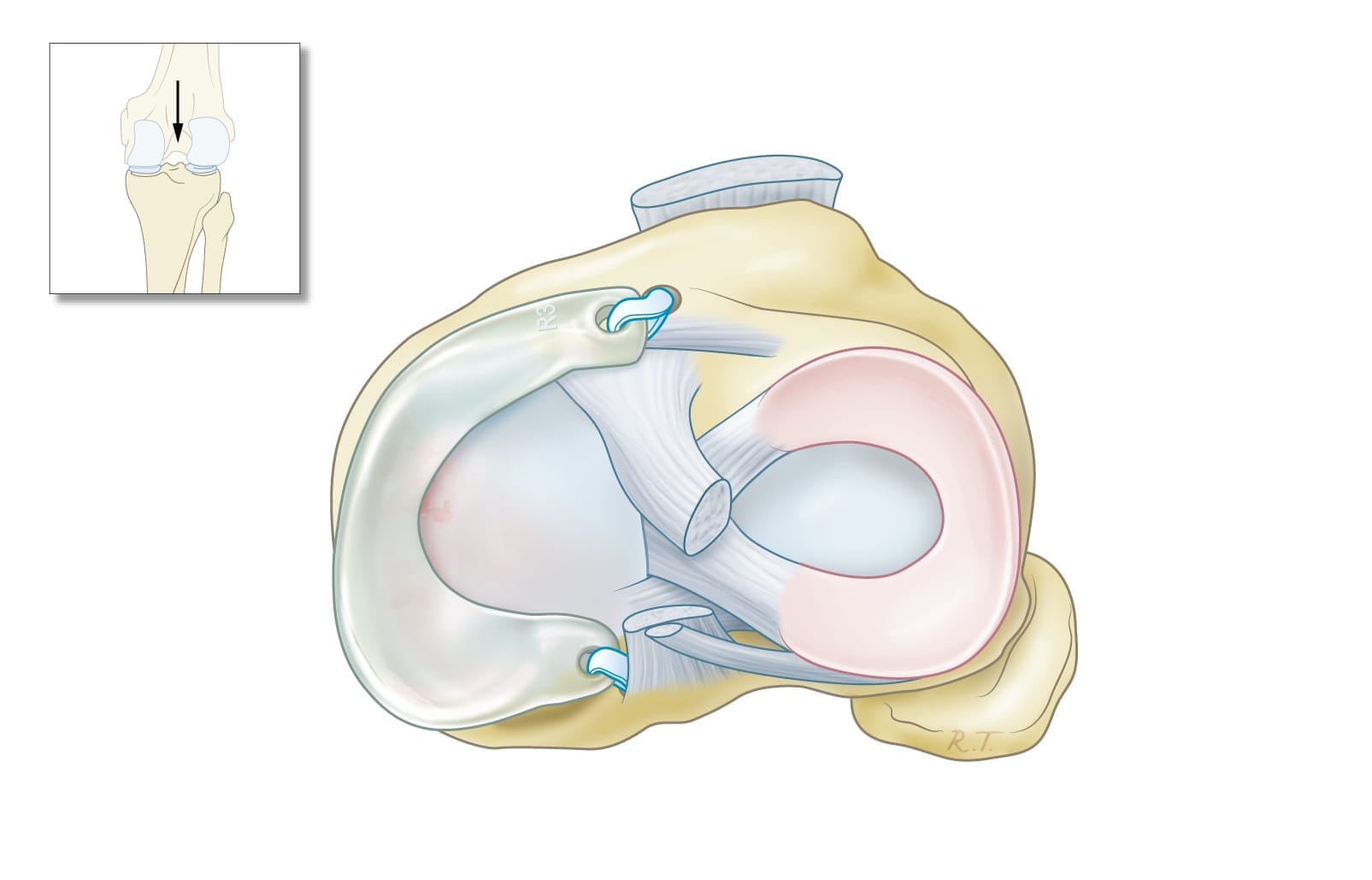
Clinical research
A viable innovation requires a great deal of research. That is why St Maartenskliniek Nijmegen, Haaglanden MC The Hague and MUMC+ Maastricht are currently investigating the prosthesis’s effectiveness. However, even prior to this study, the necessary research had already been carried out at Radboudumc. The first implant had to be removed in four out of five patients. Nevertheless, the concept proved successful in the fifth patient. “That patient scored very well at the end of the study, which showed us that it really is possible, provided the fit is perfect,” says Maarten.
Based on this, ATRO Medical has developed an improved version of their implant. This performs much better. A study is currently underway with patients, in which the artificial meniscus is showing excellent results, particularly in terms of pain relief. This is important data, which is essential for proving the effectiveness of the Artimis® meniscus prosthesis and securing final approvals.
Follow-up survey
ATRO Medical is now on the eve of two new clinical studies. The first focuses on the inner meniscus, where they want to further demonstrate the effectiveness and durability of Artimis® with more patients. "Essential here is that we find enough patients who want to test our innovation. That way we can also statistically prove that what we are doing really works," Maarten says. ATRO is also starting a study for the outer meniscus in close cooperation with the Radboudumc, supported by a European grant. This part of the knee is more challenging because of the different load. "But we are trying to apply the same successful techniques here, only the shape of the prosthesis is different," Maarten stresses.
Together you go further
For these new studies, ATRO Medical is actively seeking new investors and participants in the research. Fortunately, they are supported in this endeavour by various parties. “Briskr helped us enormously, particularly in the early stages,” says Maarten. “They organise valuable meetings on topics such as valuation and corporate finance – crucial subjects for a company seeking to develop medical innovations. These meetings not only provided us with knowledge but also expanded our network. Both are essential for success.”
In addition to the support from Briskr, investors such as OostNL and De Brabantse Ontwikkelings Maatschappij (BOM) have also been invaluable. “OostNL and BOM were involved from an early stage and continue to play a key role in the overall financing.” These regional funds ensure that ATRO can continue to grow, but their contribution had to be supplemented with private capital.
This is where the Radboud Investment Day came in handy – an annual event where ATRO met a business angel last year who decided to invest in them. “For us, it’s crucial to constantly find new investors, particularly to fund research, both in Europe and, in due course, in the US,” emphasises Maarten. “Events like this not only provide us with capital, but also visibility and new opportunities. We look forward to days like these. It’s nice to have a home game every now and then. It’s great to see the cross-pollination: all these wonderful developments in Nijmegen that help each other move forward.”
A bright future
With new courses on the horizon, ATRO Medical is looking to the future with confidence. One of the most futuristic developments is the collaboration with the Orthopaedic Research Lab on an AI-generated, personalised meniscus, which is fully tailored to the individual patient’s knee. “We have recently received a grant to develop a personalised 3D-printed meniscus based on MRI scans,” Maarten shares enthusiastically. Such an innovation could well be the next step in the evolution of implants, preserving each patient’s knee joint. “But first, we’re bringing this design to patients with persistent symptoms following meniscus removal. And step by step, we’re getting ever closer to that goal!”
This article is from Briskr.