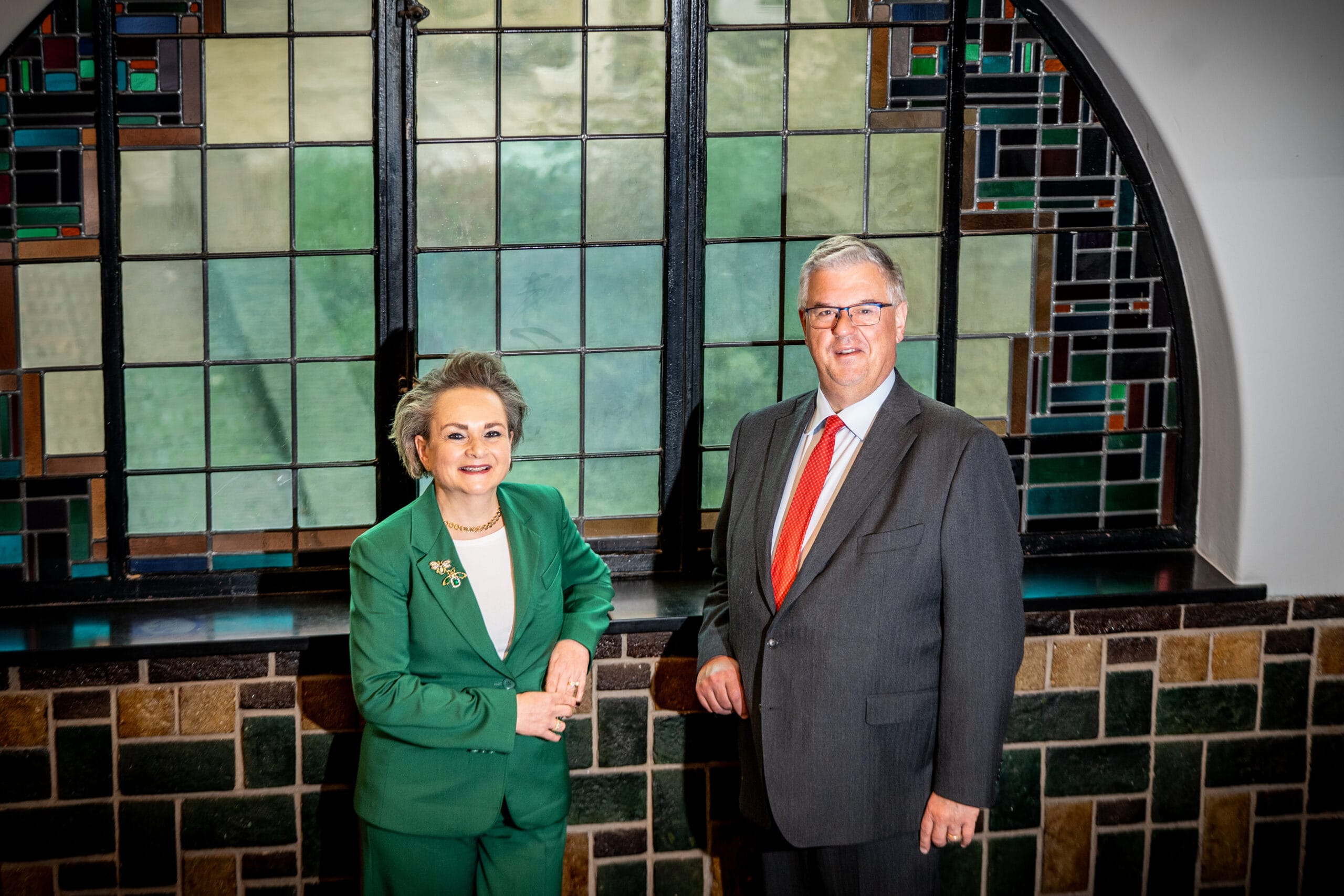
On Entrepreneurs’ Day, the Board met at Arnhem Town Hall. Councillor Nermina Kundic spoke about the city’s economic direction: Arnhem is working towards a strong, future-proof economy, and by 2026 aims to be both a city for SMEs and a city of education. Innovation, the circular economy, the maritime manufacturing industry, tourism and vibrant shopping centres are the key priorities on the economic agenda. The message is clear: Arnhem and the Lifeport region want to move forward – and they are doing so together.
A region reinventing itself
Tycho Tomassen and Marcel Hielkema are taking the Board through the regional energy narrative. The figures are impressive: €2 billion in annual added value, 15,000 additional jobs, and a unique energy, testing and demonstration infrastructure that sets the region apart nationally. Lifeport Regio Arnhem Nijmegen is the leading national energy region, with electrification at its very heart. Connectr is the driving force behind this movement and, together with The Economic Board and various energy partners from the region, will draw up the implementation plan for 2026.
The people behind the transition: the Energy Talent Plan
A strong Energy region requires a sufficient number of skilled professionals. That is why the Energy Talent Plan forms an essential part of the strategy. The Energy Talent Plan is a regional collaboration between the education sector, government and businesses to tackle the looming shortage of energy professionals. The challenge is considerable: over the next ten years, 15,000 additional energy professionals will be needed to keep the Netherlands running on sustainable energy – both for innovation and for implementation.
The Talent Plan focuses on three interlinked programme strands: recruitment, training and retention. Connectr and SEECE, with strategic involvement from The Economic Board, will set to work on developing projects, KPIs and start-up funding. The Board agrees: this is not the sole responsibility of the education sector. The entire region – education, businesses and public authorities – must work together. Training talent is one thing; retaining talent is just as important.
The pressure on the morning rush hour: a region that moves
Mobility is also a key focus. The growing pressure on the morning rush hour – with Tuesday and Thursday as peak days, including cycle congestion – calls for action. The interdependence between the economy, energy and accessibility is becoming increasingly apparent. The solution lies in collaboration. Educational institutions, employers, local authorities and transport operators must focus on ‘Spreading & Avoiding’: not concentrating on the mode of transport, but on the time of travel.
Previous pilot schemes have shown that adjustments to timetables and working patterns are effective. But the issue goes beyond the rush hour. It also affects childcare, sports timetables and working cultures. That is why a comprehensive approach is needed.
Moving forward together
The region faces major challenges, but also significant opportunities. The choices being made now – regarding electrification, talent development and accessibility – will determine Lifeport’s economic strength and quality of life in the coming decades. And importantly: the focus is not just on ambitions, but above all on concrete steps. From plans to action. Lifeport is working together to build a strong, innovative and accessible region. Now and for the future.