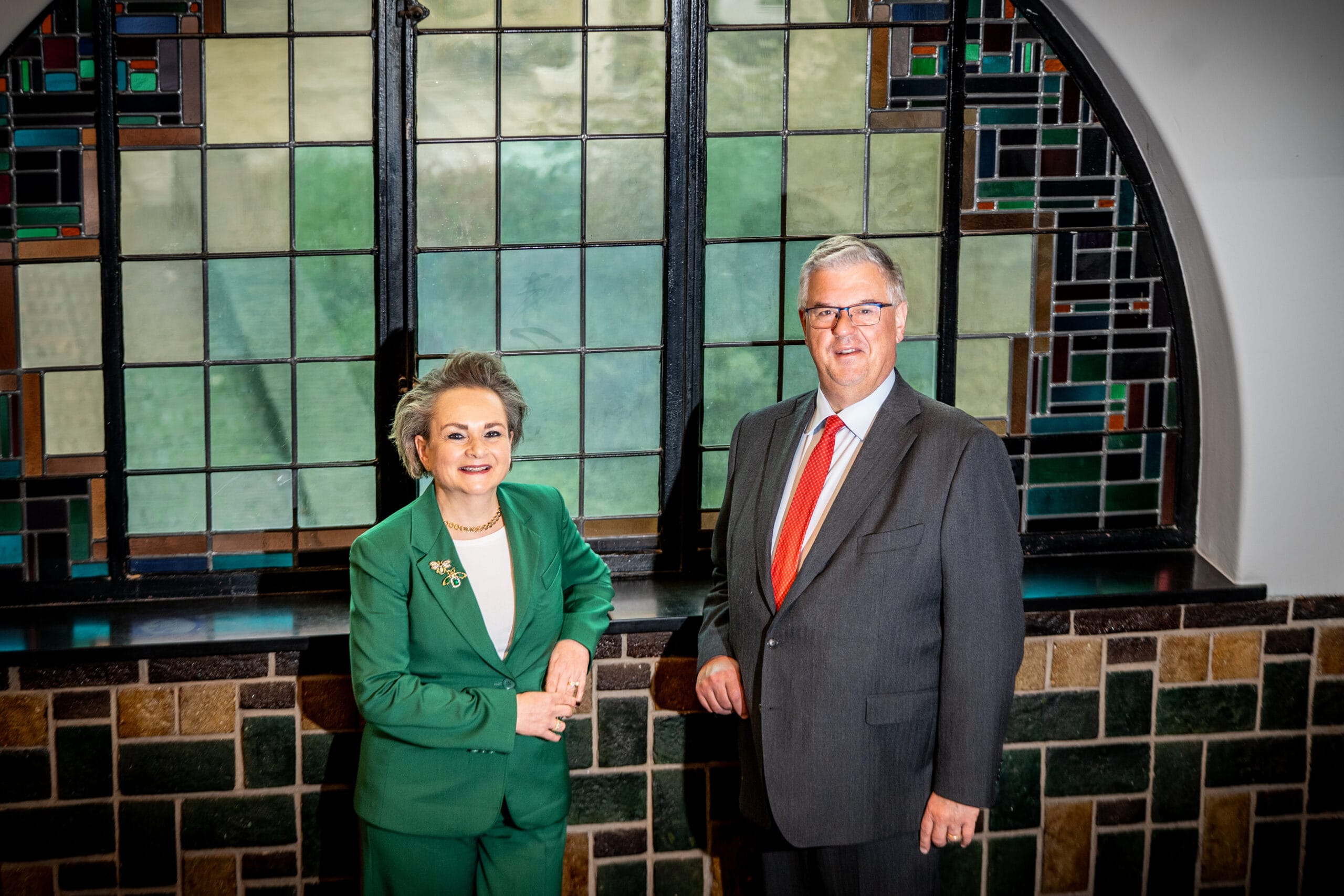
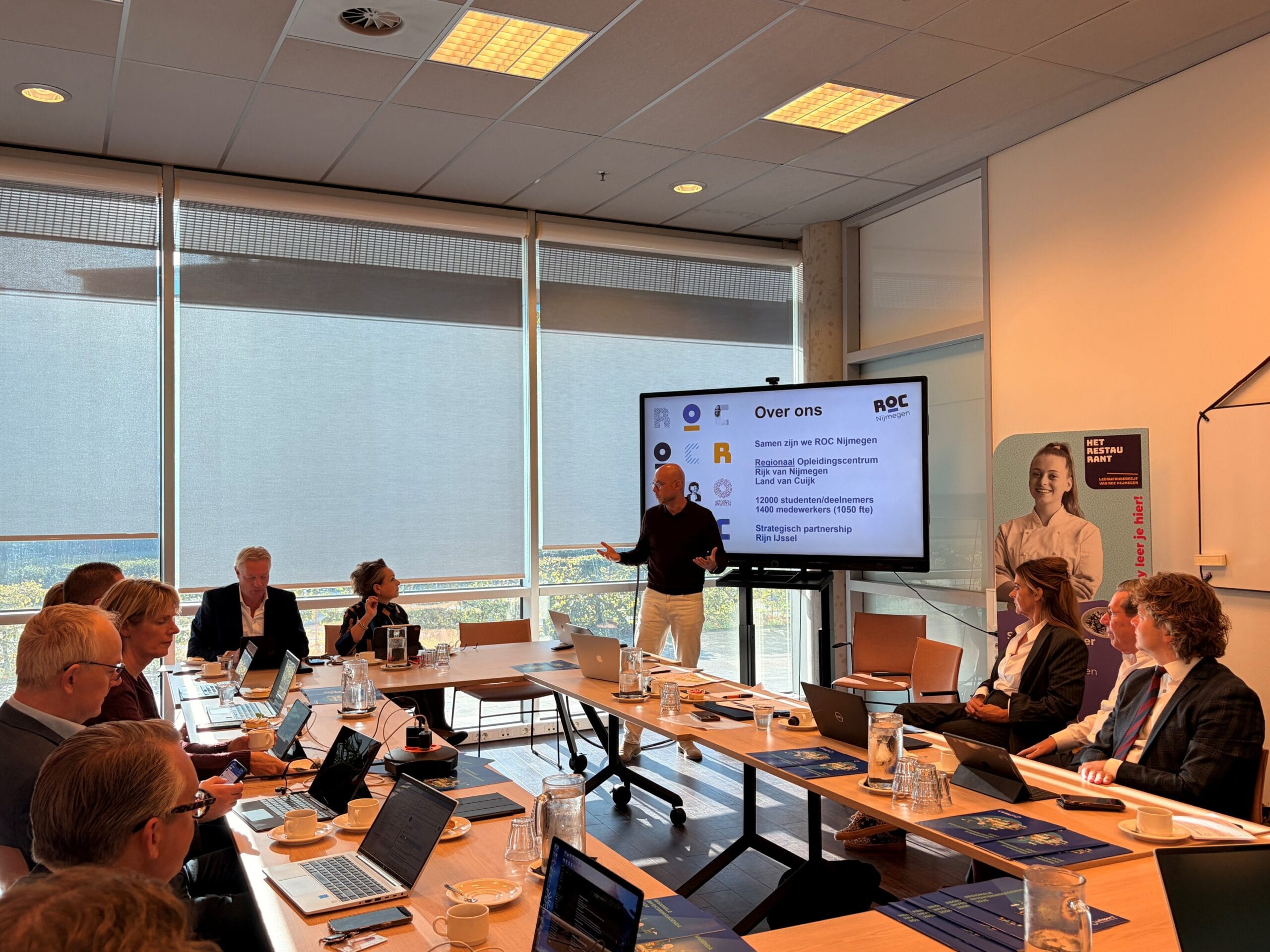
On 27 January, the first board meeting of 2023 took place on the top floor of the Erasmus Building at Radboud University. Radboud University (RU) is celebrating its 100th anniversary this year. By October 2023, it will have been making a difference for 100 years – not only to students, researchers and staff, but also to the world around us. The university in Nijmegen contributes to a healthy, free world with equal opportunities for everyone. For nearly 25,000 students of 88 nationalities, across 7 faculties offering nearly 100 programmes, the core message is ‘you are needed’. Everyone is needed to bring about the sustainable transformation we must achieve in the world!
During the meeting of The Economic Board, various topics were discussed, including artificial intelligence and the Arnhem-Nijmegen Green Metropolitan Region.
Artificial intelligence
A spearhead of our region with enormous potential is artificial intelligence (AI). The Arnhem Nijmegen region is characterised by a good number of innovation centres for artificial intelligence (so-called ICAI labs) and an increasing number of AI-related companies and applications. AI has developed steadily over the past 30 years, with an acceleration from 2006 onwards. After a first generation of systems based on knowledge rules/algorithms, we are now in the second generation of machine learning, where computers search for solutions on their own from large amounts of data. The next step - which is in full swing - is deep learning using neural networks. The Arnhem Nijmegen region has all the ingredients to make a substantial contribution to the AI position of the East Netherlands, the Netherlands and Europe. The region is home to plenty of well-trained staff, excellent knowledge (e.g. at RU, which has been working on AI for more than 30 years, and the Donders Institute for Brain and Cognition, which conducts pioneering research in neurotechnology) and companies that apply AI. In contrast, there is limited knowledge - both inside and outside the region - of how much is happening in the region in the field of AI. As a result, opportunities are missed when it comes to new collaborations, developing new knowledge/solutions, bringing in and retaining talent, and attracting funding. AI can add value for both residents and entrepreneurs within various domains, for instance in the areas of health & care, sustainable energy supply, the quality of the built environment and improving education.
The Green Arnhem Nijmegen Metropolitan Area
Harriët Tiemens, director Green Metropolitan Region addressed the social challenge we face as a region. The triple helix cooperation of The Economic Board education, entrepreneurs and government, can help. Our region's challenges are mainly in the physical domain: housing, circularity, economy and mobility. The aim is to facilitate growth while preserving and where possible strengthening the green character of this special region. The Arnhem-Nijmegen region is a thriving urban network, with an increasing flow of residents from the Randstad towards Arnhem. We expect our region to grow even further; in inhabitants, in employment and in mobility. We have a substantial housing requirement of some 35,000 extra homes until 2030, with accompanying increasing pressure on the region's accessibility. To manage this, we are working with 18 municipalities and other stakeholders to ensure that the balance between urban development and relaxed quality of life in the region is maintained? Therefore: green growth!