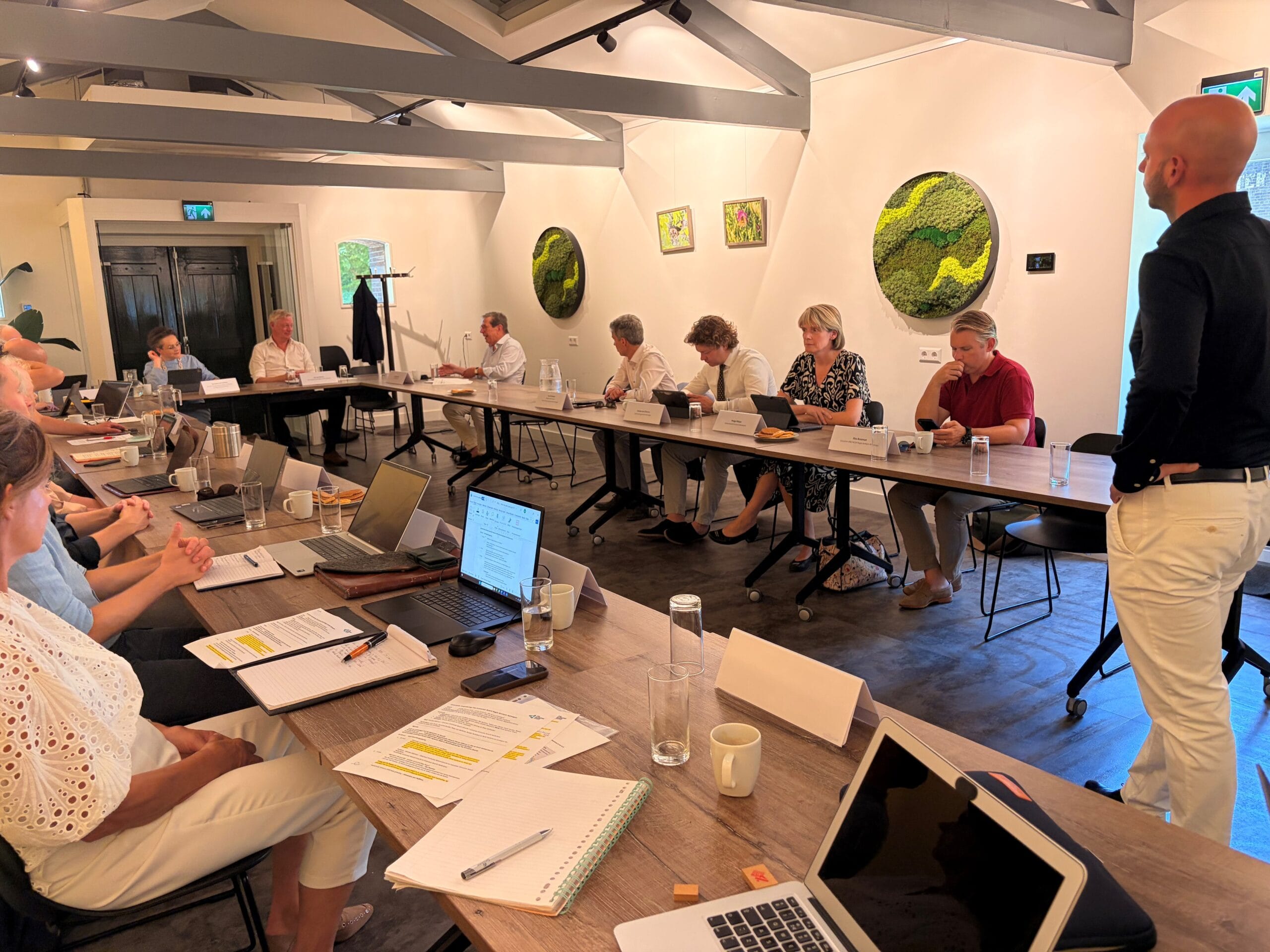
The Economic Board is a triple helix partnership in which entrepreneurs, governments and educational institutions work together. The board members meet once every two months to discuss their joint efforts for a vital and sustainable life in Lifeport Region Arnhem Nijmegen.
Semicon
The board meeting on Friday 29 November took place at NXP Semiconductors in Nijmegen. Jean Schreurs, director of NXP Netherlands, talked about the semicon industry. NXP in Nijmegen has a rich history rooted in Philips' history. Although NXP's international headquarters is in Eindhoven, Nijmegen plays a vital role in chip production and houses the company's largest R&D department (about 2,750 employees from 60 different nationalities). In terms of activity, the Arnhem-Nijmegen region is the second region in the Netherlands in the field of semiconductors. NXP in Nijmegen is the only chip factory in the Netherlands that has been supplying billions of chips around the world for decades. Not only for cars and consumer electronics but also for in bank cards and phones.
Strategic Plan 2026-2030
The agenda for the meeting included the new Strategic Plan 2026–2030. The Economic Board acts and invests in our region based on a strategic economic agenda, with the aim of improving overall prosperity and tackling major challenges jointly with our partners. We are living in an era of major societal transitions – internationally, nationally and regionally. Think of transitions in the fields of energy, raw materials, protein, water, healthcare, digitalisation and the labour market. The period 2026–2030 looks set to be a pivotal one in this regard.
For Lifeport Regio Arnhem Nijmegen, this has two implications. On the one hand, the region must successfully navigate these transitions itself, whilst also grappling with the underlying problems (such as grid congestion). On the other hand, these underlying challenges also present many opportunities to contribute to the solutions through innovation and, in doing so, to strengthen our region’s economy. Our Energy and Health clusters tie in directly with this, whilst High Tech, in a broader sense, can provide many solutions to societal challenges. For example, innovation within the Energy cluster can help resolve grid congestion issues for our region whilst simultaneously delivering products and services that can be successfully marketed.
The decision to focus our programmes and projects on the Energy, Health and High Tech clusters aligns well with both the national and European economic agendas, as well as with the call to direct economic activities towards societal challenges and transitions. For the clusters, integration with themes such as Food, AI, digitalisation, the labour market and smart sustainability is essential. Over the coming months, feedback on the draft version of the strategic plan will be incorporated so that the Strategic Plan 2026–2030 can be adopted at the next board meeting.
Dashboard
Nicky Hogenkamp, programme manager at The Economic Board and IT Student Lab students Daan Verlinden and Job Sluiter, presented the Dashboard they realised for The Economic Board. One integral overview of all programmes and projects with the aim of focusing, prioritising and making choices and measuring impact. IT Student lab ensures that students gain practical experience and are introduced to the various companies and organisations in the region. Their first assignment was at The Economic Board, building a dashboard.
Thank you
This was the last meeting of Jean Schreurs and Daniël Wigboldus. The chairman thanked them for everything they have meant for the Board and Lifeport Regio Arnhem Nijmegen! Their enthusiasm and expertise have been invaluable!