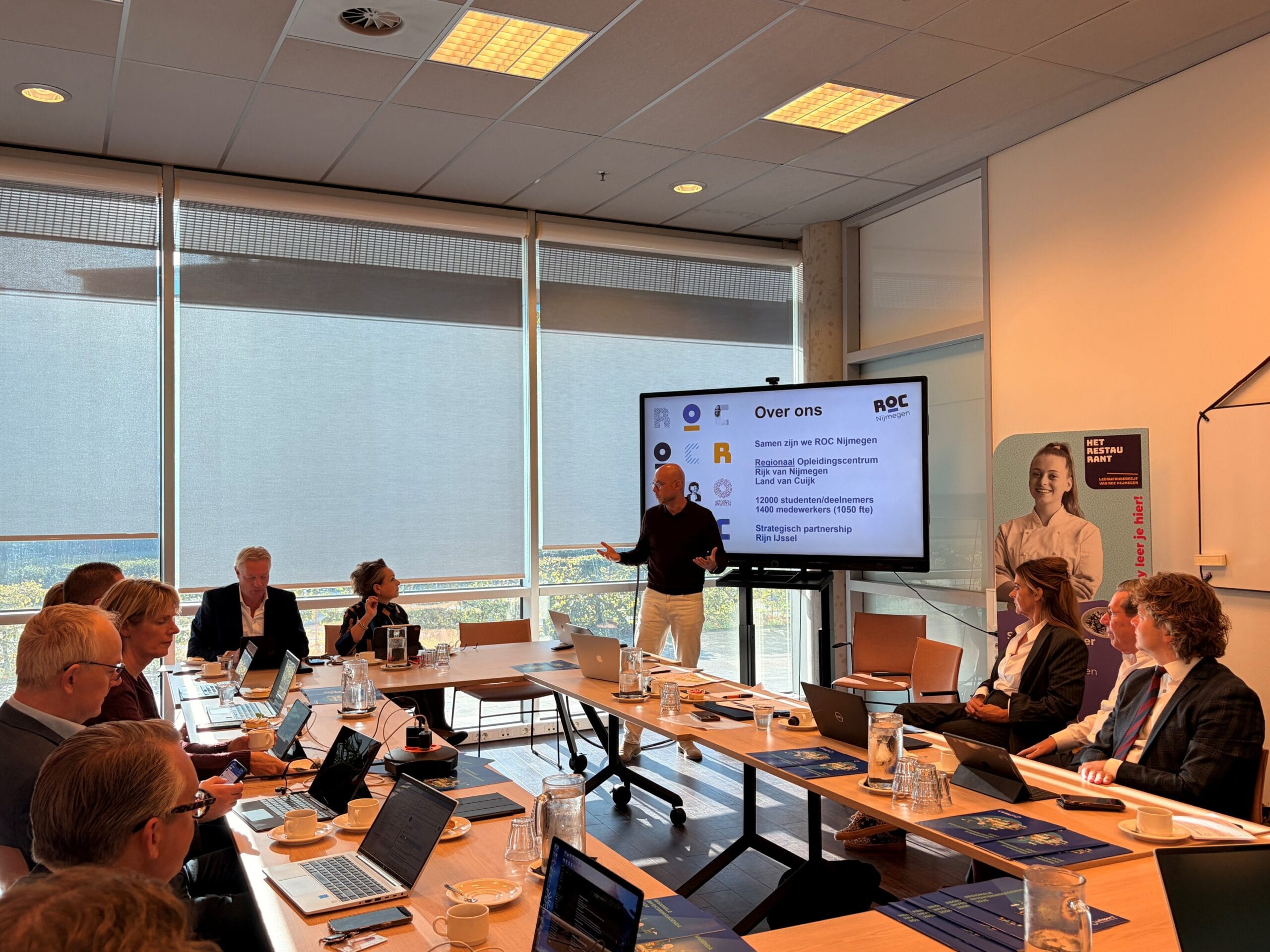
The Economic Board is a triple helix partnership between entrepreneurs, public authorities and educational institutions. Every two months, the Board members meet to discuss their joint commitment to healthy and sustainable living in the Lifeport Arnhem-Nijmegen region.
The board meeting on Friday 21 June took place at the Huis der Provincie in Arnhem. Helga Witjes, Provincial Executive Member responsible for Finance, Economy and Innovation, and also a member of The Economic Board, explained the tasks and responsibilities of the Province of Gelderland. She discussed both national responsibilities and the province’s own policies, as well as the coalition agreement and the associated challenges.
Tasks and Responsibilities of the Province of Gelderland
- National responsibilities and provincial policy: An overview of the role the province plays in national governance, as well as the specific policy measures implemented within the province. Responsibilities delegated to the Province by central government include: Sustainable spatial development / Environment, energy and climate / Vital rural areas and nature conservation / Regional accessibility / Regional economy / Culture and heritage conservation / Supervision of local authorities
• Coalition Agreement: The agreements and plans set out by the current coalition, aimed at economic and social development.
Challenges
- Just do what can be done, but not everything can: The importance of setting realistic and achievable goals within constraints.
- Grid congestion: The impact of limited grid capacity on housing, infrastructure and business parks. This problem hinders further development and growth in the region.
- Nitrogen: Case law compels visible nature restoration and reduction of nitrogen emissions. This requires far-reaching measures to meet legal requirements.
- Attracting high-quality personnel: It is a challenge to find enough qualified personnel, which is crucial for further economic growth and innovation.
- Uncertainty in The Hague: Political uncertainties and changes in policy at the national level create instability, which complicates long-term planning and implementation.
The meeting highlighted the complexity of the issues facing the region, and the need for cooperation and pragmatic solutions to move forward.
Cluster Energy
The agenda for the board meeting included, amongst other things, an update on the Energy cluster. Tycho Tomassen, Energy Strategist at The Economic Board, provided an explanation of the projects and programmes within the Energy Cluster’s five action lines. Within these action lines, various programmes and projects are being carried out, centred on triple helix collaboration between businesses, public authorities and educational institutions.
Key points from the Energy Cluster update:
- Space and infrastructure for business: Initiatives to create sufficient space and the right infrastructure for companies to grow and innovate.
- Stimulating innovations (business development): Projects aimed at promoting innovation within business, including supporting startups and scale-ups in the energy sector.
- Sufficiently qualified staff: programmes that focus on attracting and retaining qualified staff, which is crucial for the growth and success of the energy sector.
- (Inter)national positioning: Actions to put the region on the international map as a leader in the field of energy, including participation in international trade fairs and collaborations with foreign partners.
- Strengthening cooperation: Promoting partnerships between companies, governments and knowledge institutions to achieve common goals and exploit synergies.
The Board members provided valuable input to complement the Helix model and strengthen the memo. Their contributions help to further optimise and make the strategies and programmes effective.