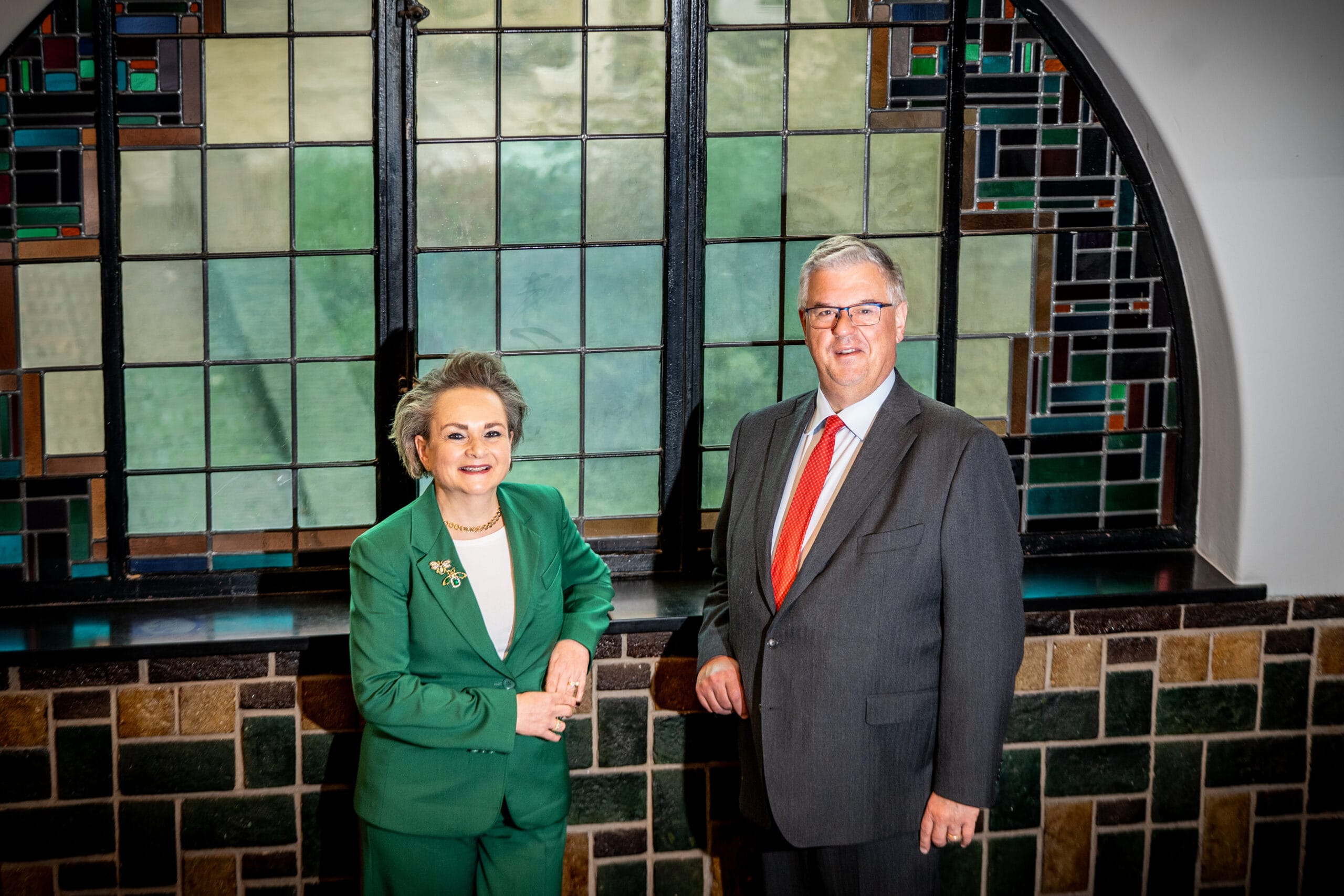
The site in Nijmegen where Philips manufactured chips until 2006 is now home to the Noviotech Campus. There, as well as at other locations across the Lifeport region, there is a thriving ecosystem of companies in the chip industry. Jan van Dellen (director of The Economic Board), Doeco Terpstra (Vice President of NXP) and Tom van der Dussen (semiconductors cluster manager at High Tech NL) explain why high-tech is so important and exactly what the Lifeport region excels at.
“We’re truly among the very best in the Netherlands when it comes to high-tech, with everything that’s happening at the Noviotech Campus,” says Jan van Dellen proudly of the Lifeport region. “With Ampleon, Nexperia and ourselves, you have three global players,” explains Doeco Terpstra of NXP.
“There’s simply a great deal here in the region: large companies, small businesses and start-ups. I’ve noticed that the Noviotech Campus is working well. Many start-ups make use of the network centred around semiconductors. They can be assisted with, for example, design, testing and failure analysis.”
Tom van der Dussen of the national trade association High Tech NL also speaks highly of the Lifeport region. “With NXP, you have the only high-volume chip factory in the Netherlands, and there’s a hugely diverse ecosystem surrounding it.”
Quote from
: “Every car in the world contains at least five to ten chips from this region”
The region’s global impact is significant, Terpstra explains, giving an example. “Every modern car on the road worldwide contains at least five to ten chips that come from here. I can make that claim without hesitation. The chips can be found, for example, in the radio, the airbag, the car key or the electrical system.”
Specialisms in chips
The world of semiconductors is vast and, to outsiders, complex. According to Van der Dussen, the four major semiconductor clusters (Nijmegen, Eindhoven, Enschede and Delft) all have their own unique strengths. “There is a great deal of expertise in RF technology (radio frequency, ed.) around Nijmegen, which dates back to the Philips era. In addition, the region excels in packaging and heterogeneous integration: packaging chips and processing them into something that can be used, for example, in a car or a laptop. There is also a growing body of specialist knowledge in chip design, including work on the new material GaN (gallium nitride, ed.).”
Terpstra agrees with these key areas. “But I always tend to look at it from a slightly more meta-level perspective. Because whilst we are certainly good at RF chips, we’re also good at chips for the automotive and security sectors. As I see it, we’re particularly good at chip production. That’s what makes us unique. There’s also a great deal of expertise in chip design, and there are machine specialists in the region, such as Besi from Duiven. And then there are the test facilities at EPR, for example.” Van der Dussen praises the ecosystem in and around Nijmegen. “The Noviotech Campus plays a key catalytic role, organising activities and facilitating the exchange of knowledge. Briskr is also very important in this regard.”
High-tech and care
The Lifeport region is also distinctive for its cross-fertilisation with technology in healthcare. Van Dellen: "We have many companies at the intersection of health and high-tech. In that, this region is really unique in the world. You can already see that in beautiful concrete applications." Terpstra: "You see a lot of start-ups emerging in medical high-tech. For that, you are really perfectly located here."
Global challenges
All three believe the high-tech sector is of vital importance. Van der Dussen says: “We believe that high-tech can play a key role in tackling global challenges such as global warming and growing enough food. Think of smarter ways of heating greenhouses, harvesting fruit and vegetables using robotics, or distributing solar or wind energy. Smart networks play a major role in this.”
Collaboration is crucial. “It takes around 800 process steps to make a chip,” explains Van der Dussen. “It is said that, on average, around 60 countries are needed to produce a functioning chip. So that’s only possible if you work together.” According to Terpstra, that is indeed happening. “In our industry, collaboration is simply essential. Sometimes this happens within the region, but in the semiconductor sector it quickly extends beyond regional boundaries.”
Attracting people and knowledge
Finding technical talent is a challenge for everyone, including companies in the region. Perhaps even more so than elsewhere, Van der Dussen believes. “Radboud University is very good, but of course it is not a technical university.”
Terpstra also sees opportunities there. “HAN University of Applied Sciences and Radboud University offer a number of technical degree programmes and train very capable people, whom we’d love to see join us. But they don’t market themselves as technical universities. Perhaps there are opportunities there for the future. That is why, together with HAN, Nexperia and Ampleon, we have set up the CITC. This is a research centre for chip packaging and integration technology. It helps us attract not only people but also expertise. It is important for the region to work on this.”
“I am personally closely involved in strengthening our collaboration with HAN University of Applied Sciences,” Terpstra continues. “We’re also seeking such collaboration with Radboud University. We’re not doing this to recruit people for our own company, but primarily to keep those trained here in the region. Whether they end up working for us or for our neighbours is, in my view, of lesser importance. When it comes to popular topics such as artificial intelligence and self-driving cars, these contacts are really bearing fruit, and that’s great to see.”
Terpstra is optimistic about Lifeport’s future as a high-tech region. “I’m seeing more and more great companies moving here. We do need to continue supporting them properly with coaching, funding and a strong network. We can do that, because as a region we have a lot to offer – both to small start-ups and to large companies.”